
The Hidden Liability in Every Dental Practice Sale: Equipment No One Has Actually Valued
May 15, 2026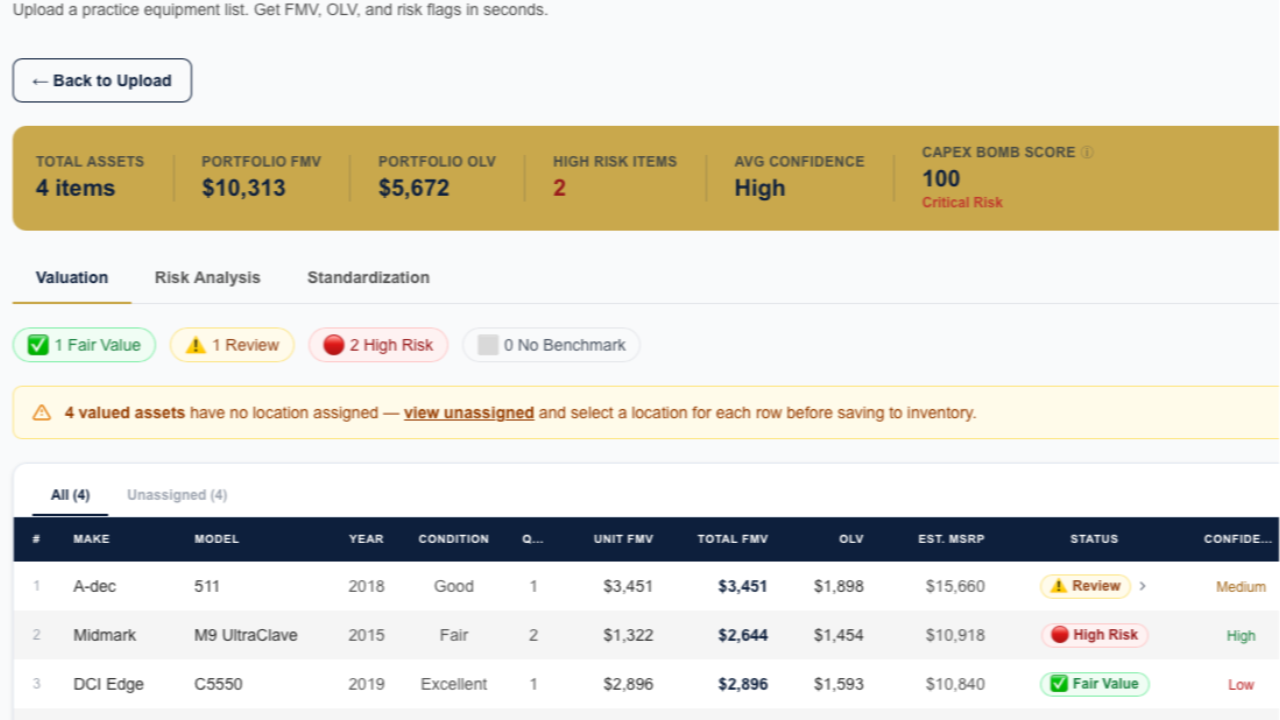
I've sat across the table from a lot of dental practice transactions — as an advisor, as a consultant, and now as the person who built the software that tries to solve a problem I watched happen over and over again. Here it is: nobody actually knows what the equipment is worth. Not the seller. Not usually the buyer. Not the broker. Sometimes not even the appraiser. And yet equipment — patient chairs, CBCT scanners, sterilizers, compressors, delivery systems, cabinetry — represents anywhere from $150,000 to over $1,000,000 in a fully-equipped dental practice. In a multi-location DSO acquisition, we're often talking about millions of dollars in hard assets that get summarized in a spreadsheet column labeled "FF&E" with a single number attached. That number is almost always wrong. And in my experience, it's usually wrong in the seller's disfavor. Why Equipment Gets Undervalued — Every Time The problem isn't dishonesty. It's that dental equipment valuation has no standard methodology. Method 1: The accountant's depreciation schedule. Your CPA took the original purchase price and ran it through a straight-line depreciation model, probably using a 7-year useful life. A $45,000 A-dec operatory that you bought in 2018 is now "worth" roughly $3,200 on paper. The actual market value of that chair, properly maintained and in good condition, is closer to $12,000 to $18,000. Depreciation schedules were designed for tax purposes. They were never designed to represent what equipment sells for. Method 2: The broker's informal estimate. Most dental brokers are experts in practice cash flow and production multiples. Equipment is not their specialty. They'll give you a number — often a rule of thumb from past deals — but it's rarely based on what comparable equipment actually sells for in the current secondary market. Method 3: Nothing at all. In a surprising number of transactions I've observed, the equipment simply gets included in the goodwill value without any separate analysis. The seller has no leverage to negotiate around asset condition or age. What DSO Buyers Are Actually Thinking Here's what a sophisticated DSO operator evaluates when they walk into an acquisition target: Replacement exposure. How much capital will we need to spend in the next 24-36 months just to bring this fleet up to standard? A practice with a 2012 CBCT scanner, three chairs with cracked upholstery, and a patched compressor isn't a problem today. It's a $200,000 problem in year two. Standardization gap. DSOs run on formularies — approved equipment lists that simplify procurement, training, service contracts, and parts inventory. Non-standard equipment creates hidden costs that get subtracted from what they're willing to pay. Insurance and compliance risk. Sterilization equipment without documentation, imaging running outdated software, compressors without recent inspection records — these create liability exposure that sophisticated buyers price in. Asset transparency. Does the seller even know what they have? The practices that can walk into a transaction with a clean, organized asset inventory consistently close at better valuations than those who can't. That same math shows up on the deal side, too — if you're modeling what a roll-up or platform acquisition is actually worth once equipment, synergies, and multiple arbitrage are in the mix, DSI's free DSO Synergy & Roll-Up Calculator runs those numbers. The Seller's Opportunity Most Advisors Miss If you're preparing a practice for sale, the equipment story is one of the highest-leverage preparation moves available. A seller who can present a complete asset inventory with market-based fair market values, condition documentation, and a clear replacement exposure analysis is negotiating from a fundamentally different position than one who shows up with a spreadsheet from their accountant. The delta is real. I've seen it on both sides of the table. And it's only half the number a buyer actually pays for — the practice-level number, built off EBITDA and goodwill, still has to be set correctly too. DSI's Dental Office Valuation & Appraisal guide walks through how those two pieces, hard assets and EBITDA multiple, come together into the price on the LOI. Three Things to Do Before Your Next Transaction 1. Run a full asset inventory before the process begins. Document makes, models, serial numbers, purchase years, and condition. This takes a day and pays for itself many times over. 2. Get a market-based equipment valuation, not an accounting valuation. Your depreciation schedule is not a fair market value. Find out what comparable equipment is actually selling for in today's market. 3. Understand the replacement exposure timeline. A practice with $40,000 in equipment replacement needs in the next 18 months is a different asset than one with a well-maintained fleet that's mid-lifecycle. Related Resources at DentalAssetIQ What DSOs Actually Pay for Equipment at Acquisition (The Real Numbers) Dental Equipment Valuation for Practice Sales: What Buyers Actually Look At Dental Equipment Due Diligence: What M&A Buyers Get Wrong What Is Dental Equipment Fair Market Value? (And How to Know Yours) Dental Partner Buyout: How to Value Equipment Without the Fight Pete Volk is the founder of Dental Strategy Institute and the creator of DentalAssetIQ, an AI-powered dental equipment valuation and asset management platform. He has over 25 years of experience in DSO strategy, practice valuation, and dental industry M&A advisory.
For more frameworks, tools, and books like this, explore the full dental strategy resource library at the Dental Strategy Institute.
Stay connected with news, offers and updates!
Join our mailing list to receive the latest news, offers and updates from our team.
Don't worry, your information will not be shared.
We hate SPAM. We will never sell your information, for any reason.